
Wire mesh demisters remove liquid droplets from gas streams. Supplied as pads, rings, sleeves, tapes and by the metre, in stainless steel and special alloys.
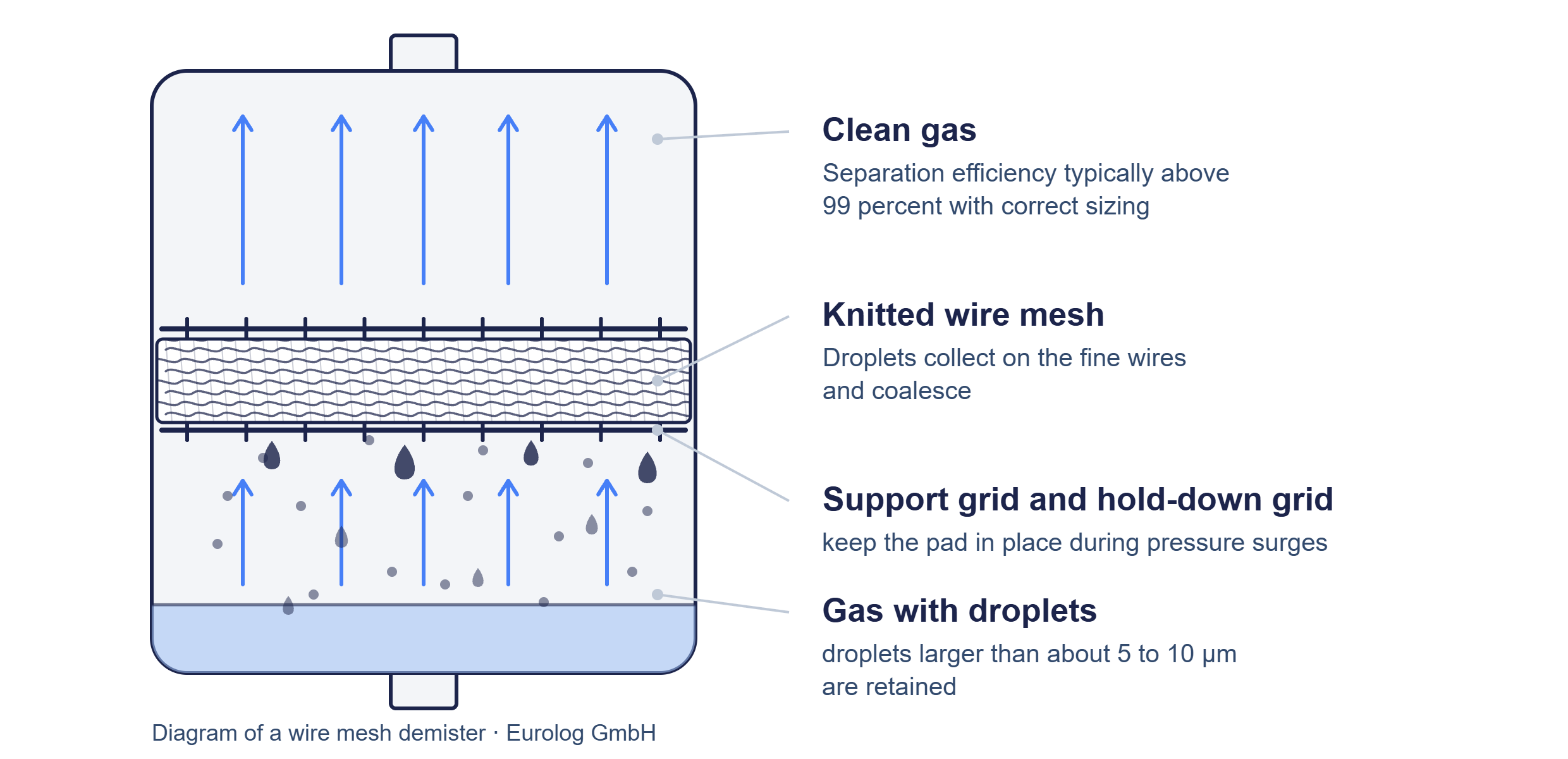
The gas flows through the knitted mesh. Liquid droplets are caught on the fine wires, coalesce and drain downwards. With correct sizing, typically more than 99 percent of droplets larger than about 5 to 10 µm are removed. Co-knitted mesh also retains finer droplets.
| Design | Knitted fine wire, crimped and layered |
| Forms | Pads, rings, sleeves, tapes and by the metre |
| Materials | 1.4301 or 1.4404 for most applications, 1.4571 where titanium-stabilised steel is specified |
| Special alloys | 1.4539, Monel 400 (2.4360), Incoloy 825 (2.4858), Hastelloy C-276 (2.4819) and nickel 201 (2.4068) for corrosive media, on request |
| Combinations | Mesh with glass fibre, PTFE or polypropylene for finer separation |
| Separation efficiency | Typically above 99 percent for droplets larger than about 5 to 10 µm, with correct sizing |
| Fine droplets | Co-knitted mesh with glass fibre or PTFE |
| Dimensions | Made to vessel size, in one piece or in segments |
| Installation | Support grid and hold-down grid matched to the vessel |
| Shielding mesh | The same mesh in copper or tinned copper |
| Delivery time | Depends on material and size, stated in our quotation |
Gas velocity. It matters more than the mesh size. If it is too low, the droplets follow the gas around the wires. If it is too high, the gas re-entrains the collected liquid.
Material. Stainless steel 1.4301 or 1.4404 covers most cases. For corrosive media, 1.4539 is often the first step. For stronger media, a nickel alloy is worth considering.
Installation. A pad needs a support grid and a hold-down grid. Otherwise it lifts during pressure surges and separation drops.
Made from copper or tinned copper, the same knitted mesh serves as shielding against high-frequency fields. Same technology, different purpose. We supply both versions.
For thermal expansion in piping and exhaust systems we supply stainless steel expansion joints.
What we need for a first sizing
Gas flow rate, medium, operating temperature and vessel diameter. That is enough to start. For production we also need material, pad thickness and quantity. We reply within 2 working days, with a quotation, a question or the date of our quotation.
We have supplied knitted wire mesh and demisters to process engineering, vessel construction and large engine manufacturers for more than twenty years.
We supply customers in Switzerland and abroad. Every export enquiry is checked against Swiss export control and sanctions regulations.
Phone +41 41 761 60 80, e-mail info@eurolog.ch
We use your details only to answer your enquiry. See our privacy policy (in German).
Send us gas flow rate, medium, operating temperature and vessel diameter. We select the right version and send you a quotation. Our website is in German. We answer in English.