
Inserts of knitted wire mesh, also co-knitted with glass fibre, PTFE or polypropylene. They remove fine droplets from gases or separate two liquids from each other. Made to measure or as a replacement for existing inserts.
Drag to rotate. Zoom with two fingers or Ctrl + mouse wheel. Example design. We supply to your drawing or specification.
| Use with gases | Fine droplets and mist from gases and vapours, for example oil mist, acid mist or aerosols in exhaust air and process gas |
| Use with liquids | Separation of two liquids, for example oil from water or water from hydrocarbons |
| Type | Pads, cartridges and rings, with support grid, frame or clamping ring |
| Mesh | Stainless steel, for example 1.4301 or 1.4404, also as co-knit with glass fibre, PTFE or polypropylene |
| Shape and dimensions | Round or rectangular, to the dimensions of the vessel or the old insert |
| Installation | Horizontal or vertical, as a replacement in existing vessels or for new separators |
| Also known as | Coalescer pad, coalescing element, coalescing filter, co-knit separator |
| Delivery time | On request, stated in our quotation |
| Other designs | On request: other sizes, materials and makes, special designs to drawing |
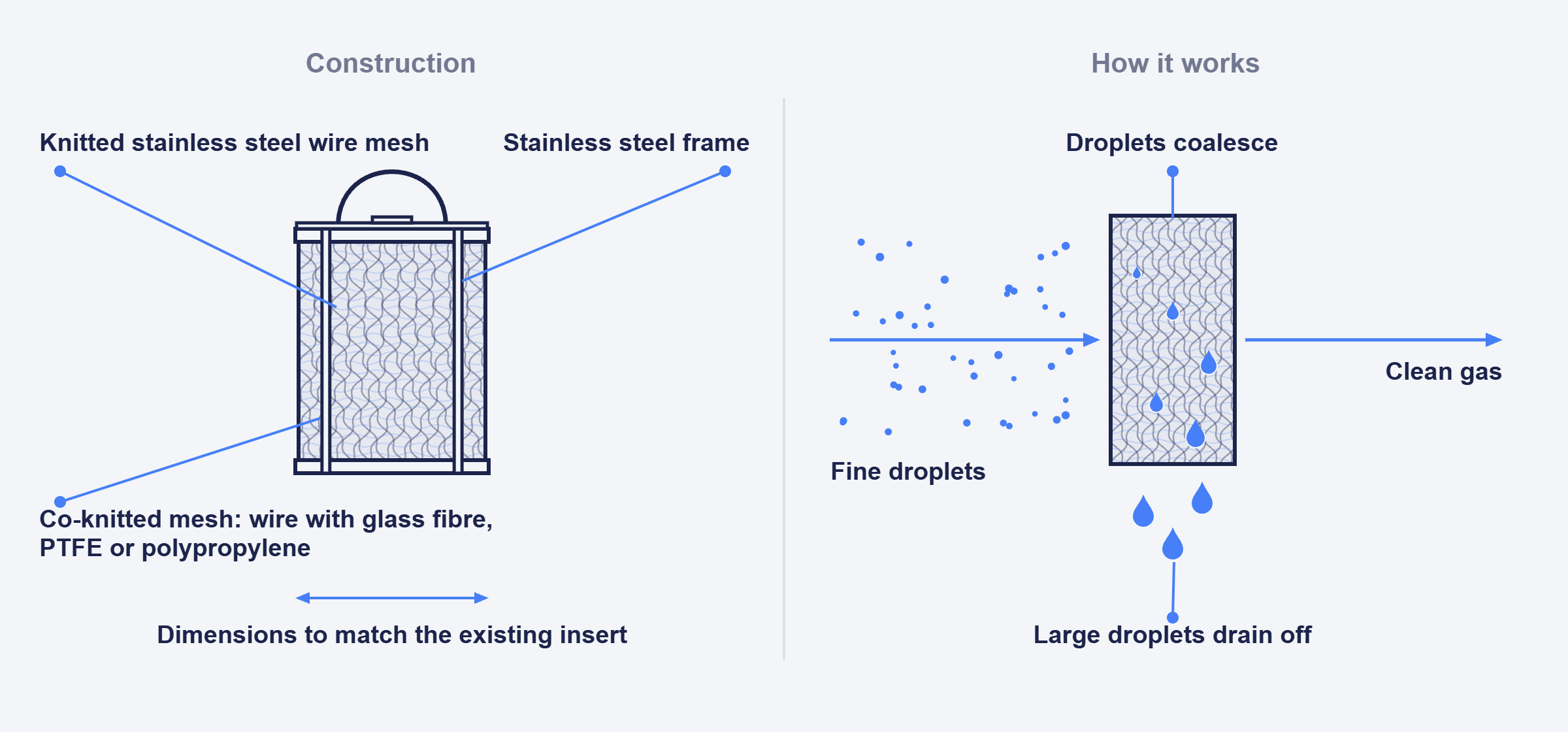
The gas or liquid flows through the insert. Fine droplets hit wires and fibres and stick to them. There they merge into larger droplets. This is called coalescence. The large droplets are heavy enough to drain off or settle.
The finer the fibres, the smaller the droplets the insert captures. That is why a coalescer insert usually contains a fine yarn in addition to the metal wire.
When a normal demister is not enough: mist is still visible after the separator, oil gets into the exhaust air or water remains in the product. A fouled or clogged insert is also a reason. You can recognise it by a rising pressure drop or poorer separation.
We source the new insert to the dimensions of the old one. Shape, thickness, mesh and mounting then fit the existing vessel.
For separating larger droplets we supply knitted wire mesh and demisters, for liquids and oils also filter elements.
A demister of plain knitted wire mesh separates droplets larger than about 5 to 10 µm. A coalescer insert also contains fine fibres. It captures smaller droplets as well, but usually has a higher pressure drop.
A mesh knitted from metal wire together with a second yarn, for example glass fibre, PTFE or polypropylene. The wire provides the shape, the fine fibres capture the small droplets.
That depends on the medium, the temperature and the chemistry. Stainless steel with glass fibre for many gases and higher temperatures, PTFE for aggressive media, polypropylene for water and oil at lower temperatures. With your operating data we propose the right combination.
Yes. Send us the dimensions, a photo or the drawing of the old insert and tell us the medium. We source a suitable replacement, even if the original manufacturer no longer supplies it.
Yes. Eurolog delivers coalescer inserts to the installation site throughout Switzerland and abroad, for example to Germany, Italy or France. We arrange transport, customs clearance on import into Switzerland and export documents.
Yes. The details on this page are examples. We also source other sizes, materials and makes, replacements for older plants and special designs to drawing. For a first enquiry a photo, the nameplate or a sketch is enough.
What we need for a quotation
Medium (gas or liquid), what is to be separated, flow rate, temperature, pressure, the dimensions of the vessel or the old insert and the quantity. A photo or a sketch helps. If your part is not on this page, ask us anyway.
We supply customers in Switzerland and abroad. Every export enquiry is checked against Swiss export control and sanctions regulations.
Phone +41 41 761 60 80, e-mail info@eurolog.ch
We use your details only to answer your enquiry. See our privacy policy (in German).
Send us the dimensions or a photo of the old insert. We find the right replacement and get back to you with a quotation. We answer in English or German.