
Linear solenoids for control and shut-off tasks. Pushing or pulling, intermittent or continuous duty, with voltage and force matched to the application.
Drag to rotate. Zoom with two fingers or Ctrl + mouse wheel. Example design. We supply to your drawing or specification.
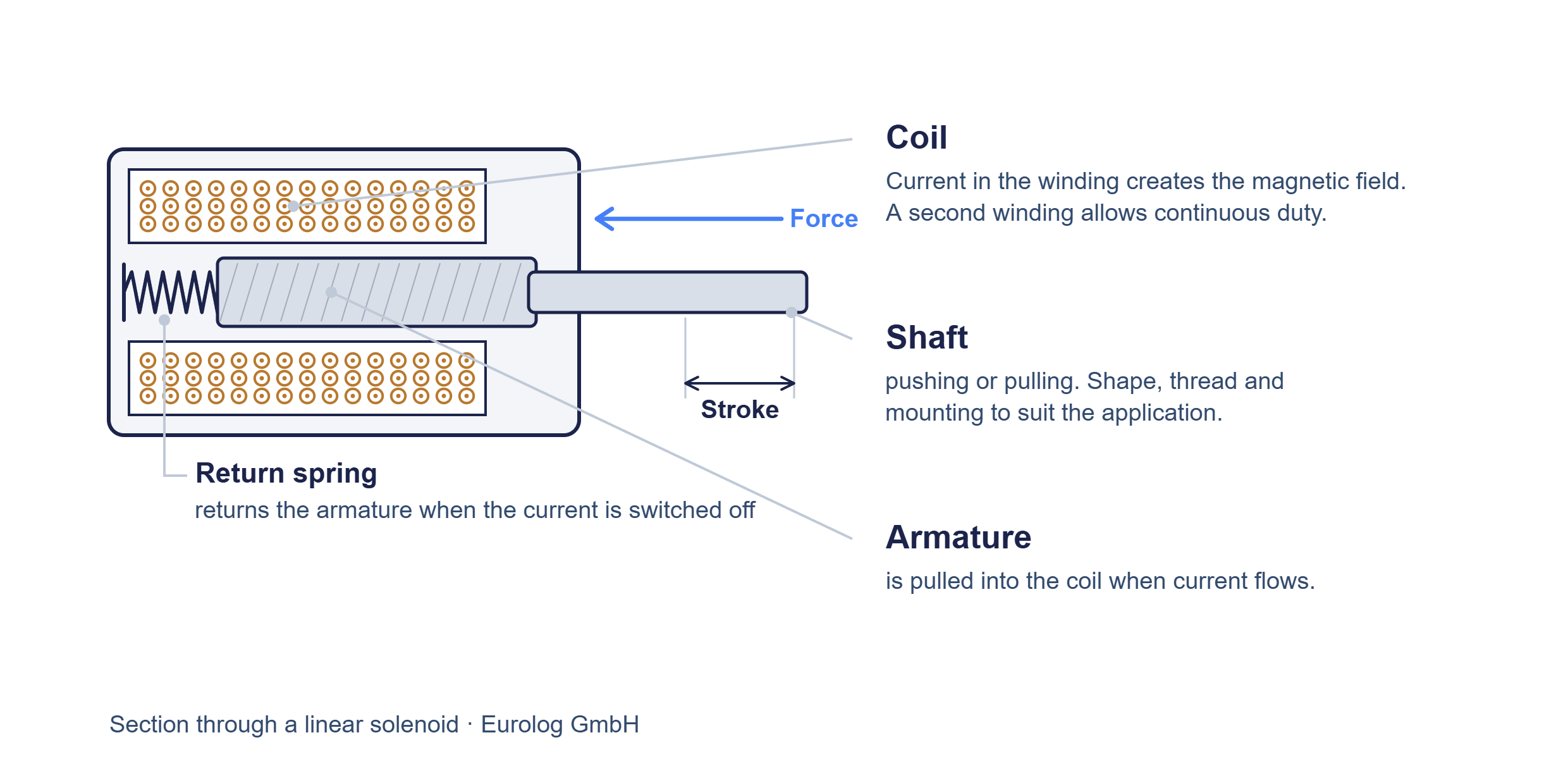
When current flows through the coil, the armature is drawn into the coil and takes the shaft with it. When the current is switched off, a spring returns the armature. No other moving parts are needed. This makes the design robust and low in maintenance.
| Designs | Push and pull solenoids |
| Winding | Single winding for intermittent operation, double winding for continuous duty |
| Duty cycle | Intermittent or continuous duty with 100 % duty cycle |
| Force curve | Rising or almost constant, depending on the design |
| Mounting | Standard version, rear shaft or front flange |
| Adaptable | Coil voltage and power, shaft form, springs, mounting |
| Common voltages | 12 V and 24 V DC or 230 V |
| Applications | Stopping engines, locking, holding, replacing small pneumatic and hydraulic actuators |
| Fields of use | Standby generators, combined heat and power plants, construction machinery, process equipment and mechanical engineering |
| Quantities | From single units to series |
| Delivery time | Depends on the design, stated in our quotation |
| Other designs | On request: other sizes, materials and makes, special designs to drawing |
This is the most common application in our range. The solenoid acts on the governor lever or the injection pump and stops the engine. Two circuits are common. With the energise-to-stop type the solenoid is energised to stop the engine. With the energise-to-run type it keeps the engine running and releases it if the power fails. Which version is right depends on what should happen if the control voltage fails.
We have supplied them for more than twenty years to standby generators, combined heat and power plants, construction machinery and workshops in Switzerland.
Force over the stroke. With a standard solenoid the force is lowest at the start of the stroke because the air gap is largest there. Towards the end of the stroke it rises steeply. Designs with an adapted pole core keep the force almost constant over the stroke. We state the force curve of your solenoid in our quotation.
Duty cycle. A solenoid for intermittent duty must not be energised continuously, otherwise the coil overheats. For continuous duty there are versions with two windings. The pull-in winding briefly delivers the high force, then the holding winding takes over at low power.
Voltage at the solenoid. What matters is the voltage that reaches the solenoid, not the nominal voltage of the plant. A long cable run or a weak battery reduces the force.
A linear solenoid that acts on the governor lever or the injection pump and stops a diesel or gas engine.
With the energise-to-stop type the solenoid is energised to stop the engine. With the energise-to-run type it keeps the engine running and releases it if the power fails. The choice depends on what should happen if the control voltage fails.
Only in the version for continuous duty with 100 % duty cycle. Otherwise a solenoid for intermittent duty overheats. For continuous duty there are solenoids with double windings.
12 V and 24 V DC or 230 V are common.
As a rule, yes. To start with, a photo of the old solenoid or its nameplate is often enough.
Yes. Eurolog delivers solenoids to the installation site throughout Switzerland and abroad, for example to Germany, Italy or France. We arrange transport, customs clearance on import into Switzerland and export documents.
Yes. The details on this page are examples. We also source other sizes, materials and makes, replacements for older plants and special designs to drawing. For a first enquiry a photo, the nameplate or a sketch is enough.
What we need for a quotation
Voltage, stroke in millimetres, required force, duty cycle and the available installation space. For a replacement a photo of the old solenoid or its nameplate is often enough. If your part is not on this page, ask us anyway.
For the same plants we supply expansion joints for the exhaust line. We usually find a suitable replacement for discontinued solenoids as well.
We supply customers in Switzerland and abroad. Every export enquiry is checked against Swiss export control and sanctions regulations.
Phone +41 41 761 60 80, e-mail info@eurolog.ch
We use your details only to answer your enquiry. See our privacy policy (in German).
Send us the voltage, stroke, force and duty cycle. For a replacement a photo of the old solenoid is enough. We find the right version and get back to you with a quotation. We answer in English or German.